

After many years of coaching C-suite leaders through career-defining moments, I’ve witnessed a pattern. Brilliant executives, who can dissect complex market dynamics and navigate billion-dollar acquisitions consistently, fumble on one critical skill: decision-making
Many senior executives admit to making decisions they later regret, because they failed to explore all dimensions of their choice. They optimized for what they could see while remaining blind to what they couldn’t. Decision-making at the top is rarely about choosing between “good” and “bad.” More often, it’s about navigating ambiguity, trade-offs, and consequences that ripple far beyond the leader themselves.
For a C-suite leader, a single decision, for example, accepting a new role, launching into a new market, or restructuring an organization, can impact thousands of lives, entire industries, and sometimes, even the leader’s own sense of purpose.
As per the ‘Decision Dilemma Study’ conducted in 2023 by Oracle and Seth Stephens-Davidowitz, New York Times bestselling author, across 17 countries, including India, it was reported that 88% leaders admitted that the inability to make decisions was negatively impacting their lives. A staggering 90% of the leaders suffered from decision distress. You can read all about the survey and its findings here.
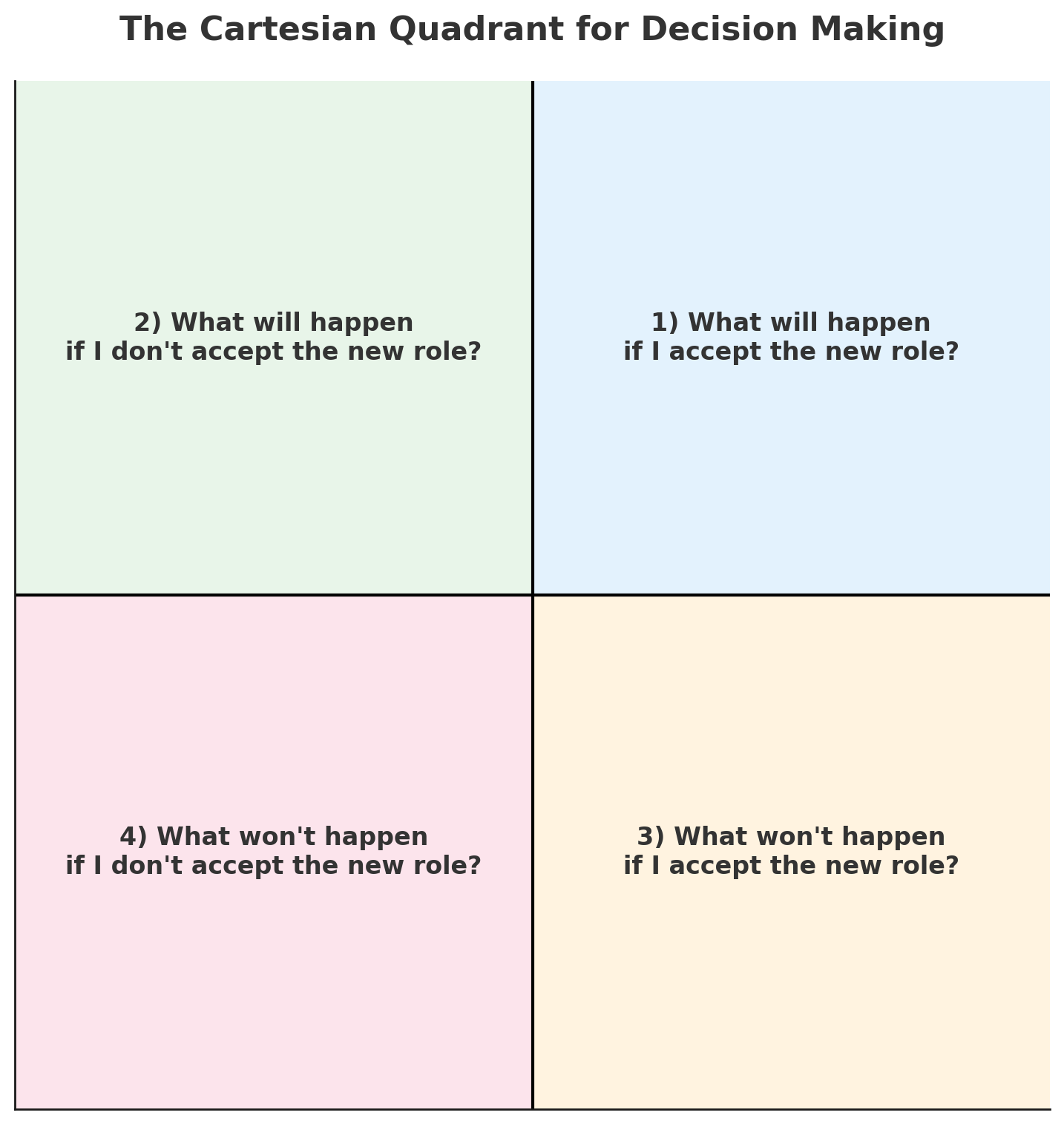
One framework I frequently introduce in coaching sessions is the Cartesian Quadrant for Decision Making. It’s simple, yet profoundly powerful in helping leaders explore the full spectrum of implications behind a choice. It forces leaders to examine their choices through four distinct lenses.
Contents
Why Leaders Struggle with Big Decisions?
Most executives I coach are seasoned decision-makers. They’re data-driven, logical, and are used to taking risks. Yet, when it comes to career-defining or life-shaping choices, they often feel stuck. The pressure at the top is unique:
- The spotlight is constant.
- The stakes are high and highly visible.
- Every decision is both professional and deeply personal.
In these moments, leaders don’t just need a pros-and-cons list. The solution isn’t more data or longer deliberation. They need a way to step back and look at the situation from multiple angles.
The Cartesian Quadrant: Four Questions That Change Everything.
Question/Situation: A new role is offered. I am in a dilemma to take it or not
 AI-generated Image
The framework is built around four simple, Cartesian-style questions, and we will go further by applying it to the situation above:
- What will happen if I accept the new role?
- What will happen if I don’t accept the new role?
- What won’t happen if I accept the new role?
- What won’t happen if I don’t accept the new role?
At first glance, some of these questions may sound inconsequential. But in practice, each one forces the leader to surface possibilities, risks, and blind spots they might otherwise ignore. Together, they create a 360-degree view of the decision landscape.
The Framework in Action
Quadrant 1: What will happen if I accept the new role?
This is the most obvious starting point. Leaders naturally think about the potential upside: greater influence, career advancement, financial rewards, and the chance to create impact on a larger canvas.
A few questions that I ask my clients are:
- How will your day-to-day life change?
- What new expectations will stakeholders have of you?
- What resources or skills will you need to succeed?
- What are the tangible and intangible rewards?
Quadrant 2: What will happen if I don’t accept the new role?
This is where leaders confront the less obvious costs of staying. Saying “no” often feels safe, but it comes with its own set of consequences.
Here, I ask leaders to consider:
- Will your current role evolve into something bigger, or will it remain stagnant over time?
- What opportunities might close permanently should you choose not to accept the new role?
- Will your decision affect how others perceive your ambition or commitment?
- Will declining create space for other opportunities?
Quadrant 3: What won’t happen if I accept the new role?
This is where the thinking shifts into the unknown and unfamiliar. This question invites leaders to identify what they might lose or miss out on if they say “yes.”
It can bring to the surface hidden roadblocks like:
- Time for personal pursuits, family, or health.
- The ability to stay rooted in a city or community.
- The chance to deepen expertise in their current domain.
- Loss of a current social & professional network
Quadrant 4: What won’t happen if I don’t accept the new role?
This final quadrant is often the most eye-opening. It forces leaders to consider the “missed future”—the experiences, growth, and transformations that may never occur if they choose not to step up.
Questions to reflect on include:
- What leadership muscles will you never develop?
- What impact will you never create?
- What dreams or ambitions will remain unachieved?
- What stories will you never get to tell?
How Leaders Can Use the Quadrant in Practice?
The power of this tool is not in its simplicity but in its discipline in usage when confronted with major decision-making scenarios. Here’s how I encourage leaders to use it:
- Write it down. Think through the questions and capture your thoughts in writing. This is a way to separate facts from emotions.
- Take your time. Sit with each quadrant. The most valuable insights often come from the less intuitive questions.
- Involve your network. Share your reflections with a mentor, coach, or trusted peer. External perspectives can highlight what is missed by you.
- Look for patterns. Across the quadrants, certain themes will repeat, clarifying your deepest values, fears, or aspirations.
- Weigh the Insights. Not all consequences are equal. Once you’ve mapped all four quadrants, evaluate which outcomes matter most given your current life stage and priorities.
- Sense into feelings: When we have so much data in front of us, we can lean into our feelings on each question to see how we are weighing in and what ‘feels’ right.
Suggested read:
Developing Decision Making as a Leadership Muscle
The leaders I’ve coached who thrive at the top are not those who always make the “perfect” choice. Instead, they are those who:
- Take the time to think holistically about the impact of the decision they choose to make.
- Confront uncomfortable questions with an open mind without getting emotional.
- Acknowledge trade-offs that are presented with every decision that is made.
- Make decisions with courage and clarity.
Looking Ahead
The Cartesian Quadrant is not a magic formula, but it is a powerful compass. It helps leaders navigate complexity by exploring what’s visible and what’s hidden, what’s desirable and what’s costly.
It enhances the ability of the leader to consistently see around corners, anticipate effects, and make decisions. By slowing down and exploring the four quadrants, you give yourself the gift of perspective.
You may like to read this blog published on Harvard Business School: How to Enhance Your Decision-Making Skills as a Leader

