

One of the most surprising insights I’ve gained over two decades of coaching senior leaders is this: the biggest obstacles often don’t come from the market, competition, or even organizational politics. They come from within. I’m talking about self-sabotage—those subtle, often unconscious patterns where leaders derail their own success.
Contents
Signs of Self-Sabotage
Self-sabotage rarely looks like outright failure. Instead, it hides behind behaviors that on the surface seem harmless or even admirable. Here are some patterns I’ve seen in my coaching conversations with top executives:
- Feeling stuck: Being caught in a never-ending cycle of “I do not know what to do with this.” This makes us rant with our colleagues, and we become complainers.
- Perfectionism as a trap: Waiting for conditions to be perfect to begin, even if it is a cherished dream. This is like waiting “until all planets align.” Given today’s business environments, this is unrealistic.
- Letting the inner critic take over: We are controlled by the critical voice in our heads saying “You’re no good,” “You are worthless,”, and “You are not ready.” We refuse to share our work/thoughts/ideas with others and stay silent.
- Procrastination: We stall our work until it feels safe for us. Others don’t always like collaborating with us.
- Not working on oneself: We stay rigid and refuse to learn new behaviors, especially when our limiting behaviors are pointed out. We assume that things will magically work out eventually.
- Not accounting for previous wins: Not taking time off to celebrate wins, small or big. Time is spent thinking of what to do next. This tires us, and we don’t even know it.
- Not taking time out: We strive, push ourselves, and keep goals as the only focus. Self-care is low, and only illness makes us stop. We do not know how to ask for help or hesitate to ask for help at the right time.
- Saying yes when you want to say no: We take on more responsibilities than one can handle. We are tired and do not express our needs. We draw no boundaries.
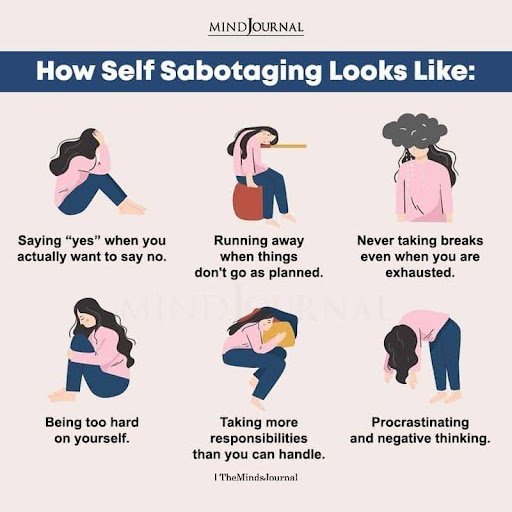
Image taken from www.artofit.org
Why Do Leaders Self-Sabotage?
Self-sabotage often has roots in deeply ingrained beliefs shaped by culture, upbringing, and early career experiences. It doesn’t happen overnight. It creeps in quietly, cloaked as overthinking, misplaced humility, procrastination, or a relentless pursuit of perfection.
In Indian society, with its rich cultural narratives surrounding duty, modesty, and “what will people say,” these patterns can become even more deeply ingrained. Several forces contribute to it:
- Conditioning Around Authority: Many of us grow up in hierarchical families and schools where questioning authority is discouraged. As leaders, this can morph into difficulty in asserting oneself.
- Fear of Social Judgment: The ever-present “log kya kahenge” (what will people say) plays heavily on leaders’ minds, leading them to avoid bold decisions that may attract criticism.
- The Success Guilt: There’s a sense of guilt in outpacing peers, siblings, or even parents’ expectations. Success feels like a betrayal, leading to unconscious self-limiting behaviors.
- Cultural Glorification of Sacrifice: Countless stories since we hear from childhood emphasize this narrative, which sometimes makes leaders feel that self-care or ambition is selfish.
3 Emotions Fueling Self-Sabotage
1. Fear
In my coaching practice as well as in leadership programs I facilitate with high-performing groups, I see these:
Fear of incompetence: We feel under-confident and hence underperform. No effort is made to move beyond a victim-like feeling. This causes disappointment and helplessness within.
- Fear of failure: There are positive and negative takeaways from mistakes. Overemphasis on the negatives creates a fear of failure, and hence, we do not initiate tasks.
- Fear of making mistakes: We expect to be perfect in all we do. To control outcomes, we also adopt micromanaging others. Sometimes we don’t start on tasks as we set high standards for what we need to produce.
- Fear of disappointing others and losing respect: Needing constant validation from others is a key factor. Being concerned about others’ opinions causes pressure. We get disconnected from what we want. We devalue our thoughts and do not express them.
These fears keep us from action. We discount ourselves and, in doing so, feel small amongst our team. We do not show up in most situations and make a poor impression at work. We can overcome fear with pause, reflection, affirmation, and a clear action plan.
Try these:
- Choose to start your day with a positive thought.
- Choose 5 affirmations you will use that week and say them to yourself once a day.
- Choose to upskill and enroll in a learning program.
- Break down a task so you can start small.
- Doing what we like every day teaches us how it feels to have consistency.
- Permit yourself to make mistakes.
- Appreciate yourself for taking action each day.
2. Shame
Shame prevents connection with others. It is a discomforting feeling, and hence we cope by emotionally withdrawing, attacking ourselves, attacking others, or avoiding others.
Early life experiences play a big part in shame. The biggest contributors to shame are critical messages from parents, caregivers, teachers, and, in our early work life, bosses.
We have heard these a lot—“You can do better,” “Keep trying hard,” “This is not enough,” “Keep quiet, your opinion does not matter.” “ How come you don’t know this?’ ‘ I am shocked by how you could do this.” “ So and so does this far better than you.” We feel shame. We feel small.
Vinay’s story: Vinay was a manager and was called to be part of an innovation team that his leader had curated. He was part of a team with 5 other talented peers. They worked on ‘seed’ ideas that their tech teams would take forward and drive.
Vinay was competitive, and each time others came up with more ideas during brainstorming and he did not, he tended to get aggressive. Each time the leader praised one of the peers and supported the peer with resources, Vinay would feel threatened and would complain to his leader about being ignored. These experiences were primarily triggered by shame and not knowing that his aggression and attacks on others came from him feeling small and feelings of inadequacy.
Shame is not an emotion we speak too much about in organizations. We feel it
- In performance appraisal cycles
- When comparisons are made in a meeting
- When we are corrected publicly.
- When we work with bullies in our teams.
- When we are manipulated by workplace politics
Try these:
- Building awareness of our thought patterns and feelings is the first step.
- Shame resilience is through self-compassion. I urge you to read more on Kristen Neff’s work.
- Seek psychological counseling if you have many hurts related to shame in your early life.
- Provide nurturing words to yourself to start your day.
- Upskill yourself so conversations can be easier and you can express your needs instead of feeling small.
- Make small goals to start with, not big, audacious ones that scare you.
- Ask a friend to celebrate with you each time you stand up for yourself.
3. Anger
Anger is often misunderstood. It is a primal response when we feel wronged. It arises when boundaries are breached. We do not express our anger due to these reasons, we tell ourselves.
- It harms others.
- It is impolite, unpleasant, and immoral.
- We fear losing respect in social situations.
- It means we have lost control.
When not expressed, anger is stuck in our bodies. It can show up at work in various forms, such as:
- A sense of urgency and always being on edge.
- We are easily offended, feel attacked when facts are listed, and so attack back, are sarcastic or caustic.
- We feel discomfort or threatened when others confront us or take a strong stance.
- We say NO a lot. An inability to manage one’s emotions causes micromanaging and controlling behavior.
- Repetitive angry outbursts. We respond out of frustration and hostility. We are reactive.
- We cannot collaborate as we are mistrustful of others. We believe that others are unfair or are out to get us.
To understand more about anger, read my blog here:
Try these:
There seems to be very little time between a stimulus and a reaction. Hence, we need to practice centering to feel balance. Download my centering practice here and use it daily.
- Begin a meditative practice a few times a week.
- Maintain a high level of activity and movement.
- Take a walk in nature so you can process your thoughts and calm down.
- Talk to a sensible friend, peer, colleague, or a coach so you get perspective.
- Upskill yourself in having tough but balanced conversations, especially with bosses and peers.
- Learn to express your needs and make requests to others.
Self-sabotage is not a sign of weakness. With awareness, support, and courage, leaders can rewrite the script. The narratives that hold them back can be redefined as strengths that propel them forward.

