
Many leaders assume that better decisions come from more data, sharper analysis or strong conviction. Working closely with several senior leaders over the years, across contexts & sectors, one pattern shows up consistently: decisions are rarely limited by intelligence. They are shaped, often shaped by how we think. There are a few shortcuts that our minds take to make thinking more efficient and decisions more effective.

While they served our ancestors well in survival situations, in the complex landscape of senior leadership, they can lead to skewed judgment, injured team dynamics, and strategic errors.
Daniel Kahneman, the famous psychologist, describes cognitive bias as – “A bias is a systematic error in thinking”. His work has shown that our minds use mental shortcuts that are often useful but can lead to predictable errors in judgment.
These shortcuts or cognitive biases are not flaws. They are a part of our human experiences and the way we observe the world around us. But when they are left unexamined, they can narrow judgment, reinforce blind spots, and quietly derail outcomes.
The following are 9 cognitive biases that deeply impact the leadership context. They show up as lived patterns in rooms where decisions carry weight.
Connected Read: The Leadership Compass: A 4-Quadrant Approach to Smarter Decision Making
1. Confirmation Bias
This is the tendency to seek information that confirms what we already believe.
In leadership, this often looks like selectively hearing data that supports a preferred strategy while dismissing disagreements without weighing them enough. We tend to seek out, favor, and recall information that confirms our pre-existing beliefs. This is perhaps the most pervasive bias in leadership.
Mindset shift: Create psychological safety and make it a habit to actively invite perspectives that differ from your own—from your team, peers, and colleagues.
Suggested Read: 9 Ways Leaders Can Create Psychological Safety At Work
2. Anchoring Bias
Simply put, we rely too heavily on the first piece of information we receive.
The first piece of information offered in a negotiation or meeting often sets the “anchor.” These drive the succeeding discussions, such as: revenue targets, timelines, and valuations, which can disproportionately shape the final decision.
Mindset shift: Pause and re-evaluate initial anchors. Ask: If we started fresh, would we land here again?
3. Availability Bias
We judge likelihood based on how easily examples come to mind.
Recent failures, visible crises, or vivid success stories can distort risk assessment. Leaders may overreact to what is memorable rather than what is statistically relevant. For example If a competitor recently had a data breach, you might over-invest in cybersecurity while neglecting the bespoke requirements of your organisation.
Mindset shift: Balance experience recall with supportive data, which is required for the present scenario. What feels important might not always be useful in the present situation.
4. Overconfidence Bias
This is a tendency to overestimate our own judgment, especially in familiar domains and situations.
Experience can become a double-edged sword. It builds intuition, but it can also reduce curiosity. Leaders may stop asking questions they once would have explored.
Mindset shift: Recognise that your past success is not always a guarantee of future accuracy in the ever-shifting leadership landscape. Stay with the information for a while before deciding.
5. Sunk Cost Fallacy
I have seen leaders struggle with projects that are clearly failing. The reasons they state to keep continuing the projects are because of prior investment—time, money, or effort. They continue to pour resources into it to justify the initial decision
Mindset Shift: Evaluate the project as if you were stepping into the role today. If you hadn’t spent a rupee yet, would you start this project now? Disassociate past investment from future value.
6. Halo Effect
This is allowing one positive trait to influence the overall judgment.
A high-performing individual may be seen as strong across all dimensions, even when evidence suggests otherwise. Similarly, successful past outcomes can overshadow current gaps.
We mistakenly assume that if a person is good in one dimension, it will automatically spill over to all other areas as well. This bias leads to poor hiring and promotion decisions, placing people in ill-fitting roles.
Mindset shift: Assess individuals based on observable behaviors and measurable outcomes, rather than broad assumptions or general impressions
7. Groupthink
In high-performing teams, especially those that have worked together for a long time, there is a hidden pressure to maintain “peace.” Leaders who value loyalty above all else often find themselves in rooms where no one disagrees. This isn’t alignment; it’s a dangerous lack of psychological safety. Teams find it difficult to express themselves and keep it peaceful superficially.
Mindset Shift: Encourage healthy disagreement. Create an environment where people feel safe to challenge ideas and have difficult conversations without fear.
Quick Reads:
8. Attribution Bias
Attributing success to internal factors and failure to external ones. When things go well, we attribute success to our vision and hard work. When things go poorly, we blame “the market,” “the board,” or “the team.” This prevents the deep reflection necessary for true growth.
Mindset Shift: This self-limiting bias withholds reflection, learning, and accountability. Hold a balanced lens. Ask yourself what have I contributed to both the successes and failures.
9. Status Quo Bias
The tendency to stick with what is familiar, even when change may be necessary.
I have coached several leaders who prefer to stick with their existing ways of working because they feel safer and more predictable. When the pressure is high, it can be tempting to choose what is known rather than explore better alternatives. But many times, change is inevitable to move forward.
Mindset Shift: Question default choices. Don’t assume the current way is the best way. Regularly ask, “If we were starting from scratch today, would we make the same choice?” Be intentional and aware.
The impact of cognitive biases on Leadership
Cognitive biases are not character flaws; they are part of how the human brain is wired. The challenge for leaders is not to eliminate them, but to develop the self-awareness and discipline to recognize when they are influencing decisions.
Whether leading through growth, transformation, or crisis, effective leadership requires the ability to pause, question assumptions, and broaden perspective before acting.
The goal is not perfect decision-making. It is cultivating awareness in the moment of decision. It is creating structures that challenge thinking rather than simply reinforcing. It is fostering psychological safety so that people feel comfortable offering different viewpoints, questioning assumptions, and surfacing concerns.
Leadership, therefore, becomes less about certainty and more about curiosity.
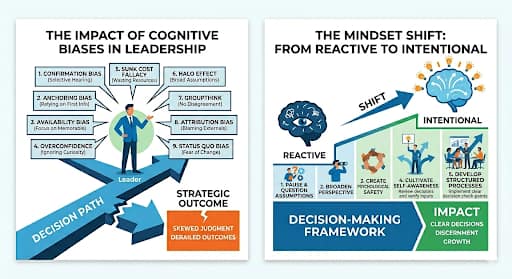
Image Courtesy: AI
A Reflection Exercise
Strong leadership is not defined by always getting decisions right.
It is defined by how decisions are made—the quality of thinking, the willingness to examine assumptions, and the discipline to pause and step back when necessary.
Take a recent high-stakes decision that you have made and reflect upon the questions mentioned below with reference to that decision:
- What assumptions did I make that I did not actively verify?
- Which perspectives, data points, or concerns did I dismiss too quickly?
- If I were making this decision again today, would I make the same choice?
- Who disagreed with me, and how did I respond?
- What emotions were present when I made this decision?
The journey from reactive to intentional leadership is ultimately a journey of awareness. As you become more conscious of the biases shaping your decisions, their influence begins to diminish, allowing you to lead with greater clarity, discernment, and impact.
To explore 1:1 coaching with me, write to team@physis.co.in. Visit the 1:1 Coaching page here
Recommended Books to understand cognitive biases
- Thinking Fast and Slow by Daniel Kahneman
- Noise by Daniel Kahneman, Olivier Sibony & Cass Sunstein
- Decisive by Chip Heath & Dan Heath